

Don’t Wait – Teach Strategy to your Students Before Their Business Simulation

Business simulations give students a chance to bring what they’ve learned in the classroom and apply it to realistic business scenarios. But before students ever face their first simulation decision, instructors have one of their own.
When should students be taught strategy?
Should you teach strategy before the simulation, or should students learn it as they go? Both approaches are common in business education, but until recently, there was little evidence showing which one works better.
Central Washington University researchers Wendy Cook and Theresa Wilson set out to answer this question. Their study followed 720 undergraduate students organized into 281 teams, using a business strategy game to compare two common teaching approaches.
The researchers gave two student groups identical coursework as well as a business simulation to complete. There was just one difference: one group learned strategy before starting the simulation (TB4), and the other group learned the same concepts while they played (TWP).
Comparing Two Teaching Approaches
To compare the two groups, Cook and Wilson looked at five common measures of business performance:
- Earnings per Share (EPS)
- Return on Equity (ROE)
- Stock Price
- Image Rating
- Credit Rating
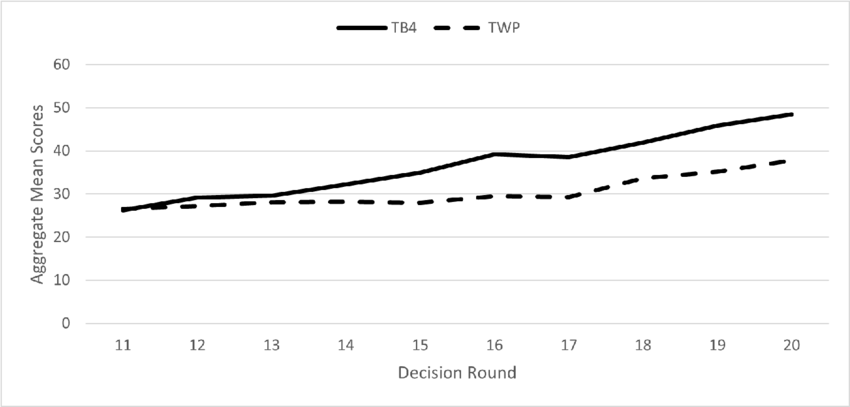
The results were clear. The students who learned strategy before beginning the simulation outperformed those who learned strategy as they played. The advantage wasn’t just noticeable—it was statistically significant.
Even more interesting, the performance gap appeared early. Both groups started at about the same level, but after only a few decision rounds, the teams that learned strategy first began pulling ahead. By the middle of the simulation, they had built a lead that the other teams never overcame.
For instructors, this finding reinforces an important concept: that preparation before the simulation shapes what students are able to accomplish throughout the rest of the experience.
Why Does Teaching Strategy First Make Such a Difference?
Why did one group perform better than the other?
The researchers point to cognitive load. In simple terms, students can only process so much new information at a time.
Business simulations ask students to do many things at once. They must learn how the simulation works, read reports, work with teammates, respond to competitors, and make business decisions. Learning new strategy concepts at the same time can make those first rounds even more challenging.
As Cook and Wilson explain, “Without appropriate strategy theory support, the complexity of a business strategy game … can quickly tax working memory, lead to cognitive overload, and reduce overall learning.”
Students who learned strategy before they began the simulation could focus on applying what they already knew. Students who learned strategy during the simulation had to learn new concepts while also making important business decisions.
How Early Decisions Create Lasting Effects
Learning strategy before the simulation didn’t just help the TB4 students get started. Their early informed decisions had a compounded effect on their success over time.
Many business decisions take time to pay off. Investments in advertising, employee training, research and development, and production capacity often require several decision rounds before results appear.
Students who began with a clear strategy were better prepared to make these long-term decisions early. Students who were still learning strategy often made important choices before they had the understanding to develop a clear plan. Because each decision builds on the last, those early choices became harder to change as the simulation continued.
Rather than spending the opening rounds developing a strategy, the strongest teams were already putting one into action. This created another factor for the successes of the learning-strategy-before group.
Your Takeaway as a Business Educator
Business simulations give students the chance to put business strategy into practice. This research suggests they are better prepared to do that when they learn core strategy concepts first.
For instructors, that means a small change in timing can make a big difference. Teach strategy before students make their first decisions, and then let students put it to work.


Arden Jordan is a marketing associate at Marketplace Simulations and a graduate of the University of Tennessee’s Haslam College of Business. After experiencing Marketplace firsthand as a student, she now helps share its story to educators through marketing and creative content.