

MBA & EMBA Capstone Simulations
Challenge MBA and EMBA students with capstone business simulations—also appropriate for advanced undergraduate students. Students lead enterprise-wide strategy, manage cross-functional decisions, and compete in global markets. They develop the executive-level judgment required for complex business leadership.
Competitive MBA Business Simulations
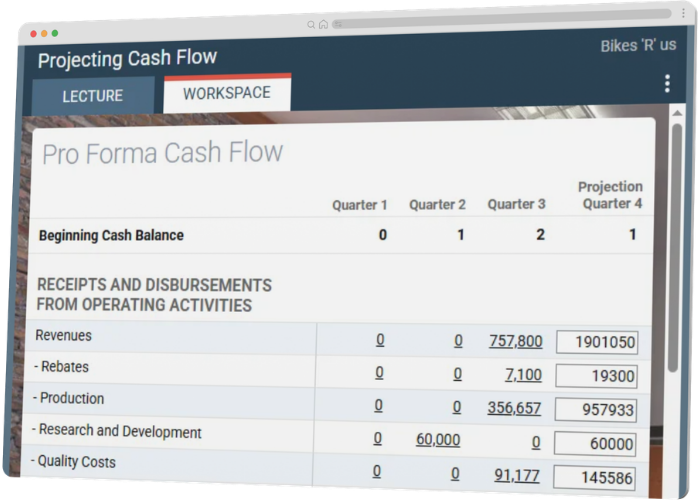
Let your students launch and lead a company in a competitive, high-stakes environment. Teams compete against classmates or the computer as they set corporate strategy, allocate resources, and manage a fully integrated global enterprise.

Strategic Corporate Management
Give students a deep understanding of the entire business enterprise in the global market. Students deal with complex strategic and tactical issues across functional areas, while balancing the interests of all stakeholders.
They’ll manage tasks in accounting, marketing, manufacturing, quality control, business partner negotiations, financial analysis, and more.

8 decision rounds, 32 to 40 hours of gameplay

20 to 40 students, parallel games recommended for larger classes

Compete against classmates
Advanced Edition
Extended Decision Rounds
- Extend the game to up to 12 decision rounds for a total of 48 to 60 hours of gameplay

International Corporate Management
Challenge your students with the uncertainty of the global market. This simulation builds on Strategic Corporate Management by adding evolving international issues and economic fluctuations.
Students will manage an international enterprise while dealing with the impact of exchange rates on profitability and learning to make the necessary adjustments in strategy.
8 decision rounds, 32 to 40 hours of gameplay
20 to 40 students, parallel games recommended for larger classes
Compete against classmates
Advanced Editions
Extended Decision Rounds
- Extend the game to up to 12 decision rounds for a total of 48 to 60 hours of gameplay
Real-Time Economic Conditions – PC Scenario
- Real exchange rates and economic conditions
- Hedging and speculative investments respond to real-life economic uncertainties
Outsourcing – PC Scenario
- Advanced supply chain options, including outsourcing and complex negotiation
- Most advanced business simulation available
- Up to 12 decision rounds of 4 to 5 hours each

Advanced Strategic Corporate Management
Help your students develop a formal strategic planning mindset within a complex international corporate environment. This simulation builds on International Corporate Management with the addition of an OST (objective-strategy-tactics) template students must complete each decision round.
Students must perform strategic analysis, strategy specification, tactical execution, and real-time control.
8 decision rounds, 32 to 40 hours of gameplay
20 to 40 students, parallel games recommended for larger classes
Compete against classmates
Management Microsimulations
In just 10 to 25 minutes, you can help your students strengthen their strategy skills. Built on microlearning theory, our Microsimulations feature a mix of animated lectures and interactive challenges. Students play each Microsimulation individually and can repeat them as many times as needed.

Microlearning for MBA & EMBA Courses
10 to 25 minutes each

Customized for your class
Any class size
These strategy-oriented Microsimulations allow your students to have bite-sized learning across multiple functional areas. This includes strategic planning, product design, production scheduling, accounting, pricing, and profitability analysis. Use our premade bundles or create an original bundle to fit your class’s needs.

Put your MBA students to the test.
We’ll help you find the best MBA business simulation for your class!
Join Professors Worldwide Who Use MBA Business Simulations by Marketplace
“I like Marketplace Simulations because it allows me to use the ‘learn by doing’ methodology in my courses. … Offering practical courses, with environments that stimulate the real world, is exciting for business students.”
—Marta Sambiase, professor at Mackenzie University
“Nothing feels better than putting your full focus and time into something and getting the reward.”
—Michael Leaback, student at Norwich Business School at University of East Anglia
Meet Assurance of Learning Standards for Your Accrediting Body





Frequently Asked Questions
What is an MBA business simulation?
An MBA business simulation is a computer-based learning experience used in MBA and senior-level business courses. Students run a simulated company in a competitive global market, making high-level decisions that shape the entire enterprise. These simulations are typically used at the end of a program because they require students to apply everything they’ve learned.
How do business simulations enhance learning in an MBA curriculum?
Business simulations enhance MBA learning by turning theory into executive decision-making. Instead of analyzing a past case, students operate a company in real time. They make strategic choices, allocate capital, respond to competitors, and adjust to changing market conditions. They also see the financial consequences of those decisions.
What makes a business simulation suitable for MBA students?
How do I choose the right capstone business simulation for my MBA course?
Do MBA business simulation games include global markets and economic uncertainty?
Yes. Many MBA-level business simulations are designed to reflect the complexity of operating in a global economy.
Can I request a demo of an MBA business simulation before adopting it?
How are MBA business simulations used in capstone or strategy courses?
Where can I find online business simulation games for MBA students?

Got questions? Need help structuring your class? Talk with our support team seven days a week!
Key Differences Between Advanced Simulations
| Simulation |  Strategic Corporate Management |  International Corporate Management |  Advanced Strategic Corporate Management |  International Corporate Management w/ Real-Time Economic Conditions – PC Scenario |  International Corporate Management w/ Outsourcing – PC Scenario |
|---|---|---|---|---|---|
| Description | Provides a deep understanding of the entire business enterprise in the global market. Students deal with complex strategic and tactical issues across functional areas, while balancing the interests of all stakeholders. This is a well-rounded management and strategy simulation. | Builds on Strategic Corporate Management and adds evolving international issues that are reflected in regional economy fluctuations. Provides an in-depth look into the management of an international enterprise while dealing with the impact of exchange rates on profitability and the necessary adjustments in strategy. | Combines the breadth of International Corporate Management with formal strategic planning templates based on the OST (objective-strategy- tactic) mental framework. | Based on International Corporate Management but with real exchange rates, economic conditions, and industry news. Hedging and speculative investments in foreign currencies are available to respond to real-life economic uncertainties. | Builds on International Corporate Management, adding advanced supply chain options, including outsourcing and complex negotiation. This is the most advanced simulation available. |
| Typical courses | Capstone, integrative business courses | ||||
| Educational level | Advanced undergraduates; MBA / EMBA‘s | MBA and Executive MBA students, undergraduate honor students | |||
| Decision rounds | 8 decision rounds of 4 to 5 hours | Up to 12 rounds (8 recommended) of 4 to 5 hours. | |||
| Class size | 20 to 40 students. The optimal game size is 4-6 teams of 4-5 students, up to 8 teams are possible. Parallel games work well with larger classes – as many as 20 games of 25 students have been played simultaneously. | ||||
| Gameplay | Compete against classmates | ||||
| Languages | English*, Spanish | English*, Portuguese-Br, Polish | English | ||

India
Undergraduate Programs
Art of Learning India

Kazakhstan
Urken Karakulov
Business Link
Phone: +7 (701) 777 5190
Business Link website
Contact Urken Karakulov
China
Dr. Ronnie Chen
Shanghai Hexiao Education & Technology
Shanghai Hexiao Education & Technology website
Contact Shanghai Hexiao Education & Technology
South Africa
Gary Ralph
Phone: +27 82 8528288
Marketplace Simulations SA website
Contact Marketplace Simulations South Africa
Botswana
Gary Ralph
Phone: +27 82 8528288
Marketplace Simulations SA website
Contact Marketplace Simulations South Africa
Eswatini
Gary Ralph
Phone: +27 82 8528288
Marketplace Simulations SA website
Contact Marketplace Simulations South Africa
Lesotho
Gary Ralph
Phone: +27 82 8528288
Marketplace Simulations SA website
Contact Marketplace Simulations South Africa
Namibia
Gary Ralph
Phone: +27 82 8528288
Marketplace Simulations SA website
Contact Marketplace Simulations South Africa
Zambia
Gary Ralph
Phone: +27 82 8528288
Marketplace Simulations SA website
Contact Marketplace Simulations South Africa
Tanzania
Gary Ralph
Phone: +27 82 8528288
Marketplace Simulations SA website
Contact Marketplace Simulations South Africa
Mauritius
Gary Ralph
Phone: +27 82 8528288
Marketplace Simulations SA website
Contact Marketplace Simulations South Africa
Sierra Leone
Marketplace Simulations Ghana, Ltd
Marketplace Simulations Ghana website
Contact Marketplace Simulations Ghana
Nigeria
Marketplace Simulations Ghana, Ltd
Marketplace Simulations Ghana website
Contact Marketplace Simulations Ghana
Liberia
Marketplace Simulations Ghana, Ltd
Marketplace Simulations Ghana website
Contact Marketplace Simulations Ghana
Ghana
Marketplace Simulations Ghana, Ltd
Marketplace Simulations Ghana website
Contact Marketplace Simulations Ghana
Gambia
Marketplace Simulations Ghana, Ltd
Marketplace Simulations Ghana website
Contact Marketplace Simulations Ghana

United Kingdom
Gyffard Yates
Marketplace Simulation UK Ltd
Educational Institutions
Contact Gyffard Yates

Poland
Marian Kapuscinski
iSpace Simulation sp. z 0.0.
Phone: +48-508-707-480
iSpace website
Contact iSpace Simulation


Trinidad and Tobago
Dr. Christian Stone
3 Stone Ltd
Phone: +1 (868) 770 4500
3 Stone website
Contact 3Stone

Mexico
Claudia Burgos and Gustavo Sanchez Peralta
Marketplace Simulation Mexico
Phone: +52-5555158905
Marketplace Simulations – Mexico Website
Contact Mr. Peralta or Mrs. Burgos

Colombia
Giuseppe Farco
Management & Consulting
Phone: +57-316 6 28 01 96 (Colombia)
Phone: +1 (740) 531 00 47 (USA)
Skype: giuseppefaraco
Dominican Republic
Ryno L. Senior
SIGSIM Srl
Phone: +1 (809) 856-6177
SIGSIM website
Contact SIGSIM
