
What You Should Know Before You Choose a Business Game for Your Course
Business educators are under pressure to deliver more than just lectures and case studies. Employers expect graduates who can apply theory and make sound decisions in the depths of uncertainty.
Educational business strategy games offer a proven way to meet these demands. These simulations let students build realistic businesses without real-world risk. Students get to apply theory in authentic scenarios and test various strategies in real time.
This article is a deep dive into the world of business games. You’ll learn what business games are, why they work, and how to use them in your course’s design.
For professors, the benefits of using a business game are abundant. Business games transform classrooms into living laboratories of business practice while preparing students for complex leadership and helping schools meet accreditation standards. Let’s explore the case for business games in today’s business schools.
The Case for Business Games
Today’s business students expect hands-on learning. Accrediting bodies and employers require evidence of measurable skills development.
Traditional education methods—lectures, readings, case studies—are valuable but they risk teaching students to be passive observers rather than active participants.
Business games address this gap by:
- Engaging students through competition, teamwork, and dynamic feedback.
- Building critical skills such as strategic planning, decision-making, and cross-functional thinking.
- Aligning with accreditation standards (AACSB, ACBSP) that emphasize experiential learning.
In today’s outcome-driven environment, simulations provide a high-impact experience that delivers both engagement and rigor.

What Are Business Games—and Why Are They So Effective in Education?
A business game is an educational simulation where students act as business professionals. Students build and manage companies while learning to handle core business tasks. Unlike lectures or case studies, they let students make their own decisions and see the results.
Business games can take different forms, depending on the learning objectives:
- Competitive or non-competitive: Some games pit student teams against one another in a dynamic marketplace. Others focus on meeting benchmarks or solving challenges without direct competition.
- Task-specific or full-company: Some games zoom in on a single function, such as accounting, product design, or marketing. Others let students oversee cross-functional operations. They may deal with finance, marketing, sales, HR, and supply chain management.
- Full-semester learning or microlearning: Business games come in a wide variety of durations. A cross-functional simulation can take anywhere from four to 60 hours of game time. Meanwhile, Microsimulations can teach core concepts in just 25 minutes.
The combination of academic rigor and experiential learning makes business games a powerful tool. They help students:
- Develop critical thinking by analyzing data and comparing different trade-offs.
- Practice strategic planning by weighing short-term gains against long-term stability.
- Build business acumen by making decisions that impact multiple departments in their business.
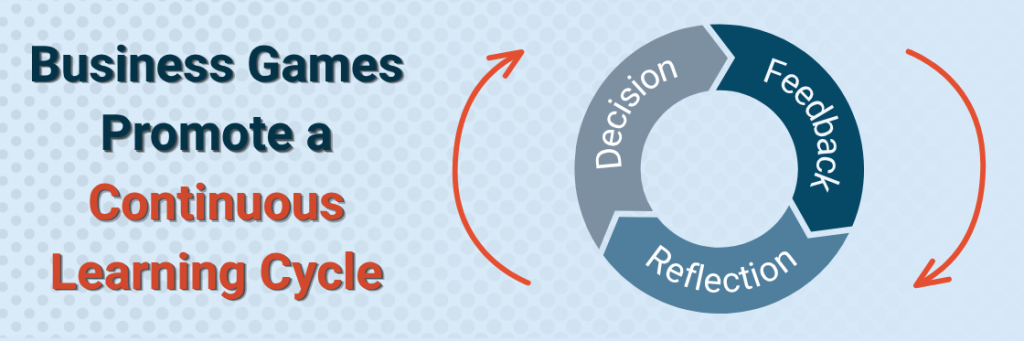
Students apply strategy, finance, marketing, and more. They then refine their approach through cycles of decision, feedback, and reflection.
Why Professors Use Business Games in the Classroom
Professors adopt business games because they transform passive learning into active application. Students don’t just memorize theories—they apply them, test them, and see their impact unfold in real time.
1. They Boost Engagement—Inside and Outside the Game
Business games grab students’ attention. Their real power is how they amplify engagement with lecture content itself. Students quickly realize that understanding business theory gives them a competitive edge. Whether it’s Porter’s Five Forces, the 4Ps of Marketing, or financial ratios, mastering the theory leads to better performance.
2. They Spark Engaging Discussions
Simulations naturally engender lively debates. Teammates start debating business theory and how it will impact their bottom line. Often, these conversations spill beyond class time, reinforcing learning.
3. They Make Lessons Stick Through Experience
Educational research consistently shows that experiential learning improves retention. The Kolb Experiential Learning Cycle describes four phases of learning that create knowledge through experience. Business games create a natural environment for each phase:
- Concrete experience
- Reflective observation
- Abstract conceptualization
- Active experimentations
Students practice concrete skills and strategy. They watch what happens and reflect on why it happened. They come up with new theories. They test their ideas. The cycle continues.
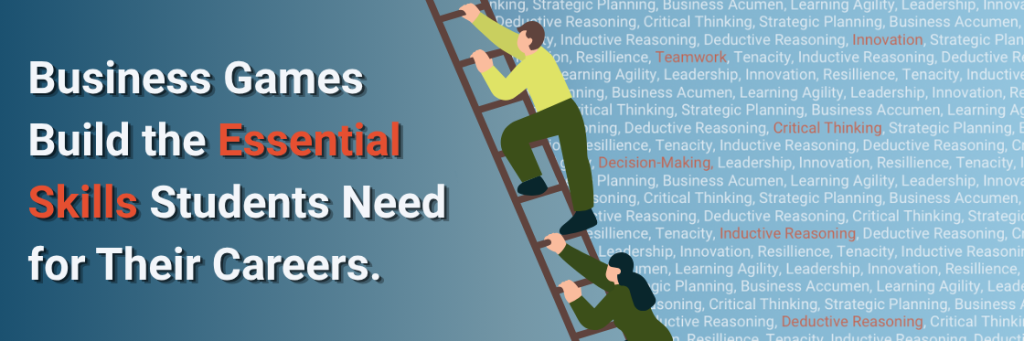
4. They Build Essential Skills
Beyond core content mastery, business games develop the career-ready skills employers expect:
- Teamwork: Students must collaborate under pressure, dividing roles and aligning strategies.
- Decision-making: They learn to weigh incomplete information and make timely choices.
- Critical thinking: They analyze data, anticipate competitors’ moves, and adapt strategies.
- Innovation: Students use market insights to create new products and strategies.
- Deductive reasoning: Students use existing evidence to make strong decisions.
- Inductive reasoning: They learn to make decisions when they have minimal prior experience.
These are the very competencies business schools promise to deliver.
5. They Align with Accreditation Standards
Accrediting bodies emphasize the importance of experiential learning in business education. For example, EQUIS calls for an emphasis on student learning and practical work. Its standards also say that, “rigorous assessment processes should be in place to monitor the quality of students’ work.”
Business games provide ample practice in business skills, as well as ongoing assessments.
Types of Business Games Used in Higher Education
Business games come in many forms. The right choice depends on your course goals, student level, and available time. Understanding the main categories of simulations helps professors choose the right fit without being overwhelmed.
Full-Company vs. Function-Specific
- Full-company simulations put students in charge of an entire business, requiring decisions across fields such as marketing, finance, operations, and HR. They can give students a broad business overview or let them integrate all they’ve learned.
- Function-specific games focus on a single discipline (such as marketing, accounting, or supply chain management) or a core concept within a discipline (such as product design or pricing). These games help students build focused expertise or master core business concepts.
High-Realism vs. Conceptual Games
- High-realism games mirror the complexity of real markets. They include a variety of variables, competitors, and data streams. Difficulty levels can range from high school to post-graduate and even corporate education.
- Conceptual games focus more on the idea of building a business than the specific elements. They may include core business principles, but they will also downplay realism. These games can get learners excited about business without necessarily diving into the details.
Peer Competition vs. Computer Teams
- Peer-to-peer simulations pit individual students or teams against each other. This creates a dynamic, competitive environment. As students build a market together, faculty can lead discussions around changing conditions.
- Computer-opponent games let students play against a variety of computer teams. This format is best for asynchronous learning or large classes. Students get the thrill of competition, but the game is much easier for faculty to manage.
Analog vs. Digital
- Analog games, such as board games or role plays, can be effective when technology is limited. They also work well for shorter workshops.
- Digital simulations offer scalability, real-time feedback, and integration with online or hybrid courses. They also provide dashboards, analytics, and assessments that simplify grading and debriefing.
Mobile vs. Desktop
- Mobile-first or lightweight games are designed for accessibility and simplified gameplay. These games are typically best suited for business students early in their education.
- Desktop or laptop-based simulations can offer greater depth and realism than mobile games. They often include dashboards, analytics, and multi-round decision-making. These games are suitable for all learning levels.
How Business Games Actually Work
Once you’ve chosen the right simulation, the next question is: what does it look like in practice? Business games typically follow a structured, multi-round process that mirrors real-world decision-making.
- Team Formation: The instructor places students on teams or lets them form their own. Teams then divide the work by department or task. This setup encourages collaboration and mirrors real-world team dynamics.
- Decision Rounds: Decision rounds may represent anything from one day to a whole business quarter. In each round, the teams make choices about how they will run their businesses. The simulation processes these decisions and updates the market environment accordingly.
- Feedback and Results: Teams receive performance reports each decision round. These can include profit and loss statements, market share data, and customer satisfaction scores, as well as other metrics.
- Iteration: Students analyze results, adjust strategies, and enter the next round. The cycle repeats until the final round, when all outcomes are tallied.
What makes this process powerful is the safe-to-fail environment. Students can test bold strategies and learn from mistakes. They can refine their approach and win market share. Win or lose, their reputations and real-world finances stay intact.

Integrating Business Games into Course Design
To choose the right business game, you should consider how it will integrate into your course. You won’t know all of the particulars before you choose a game, but there are a few things you should consider.
Placement in the Syllabus
Business games can help you achieve different learning goals depending on where you put them in your syllabus.
- Early in the course: Use a short simulation to introduce students to core concepts or give them a broad business overview. This format gives students a practical context for the theories you will introduce.
- Throughout the semester: Run multi-round games in parallel with your lectures. This allows theory and practice to reinforce one another as your students work and you teach. It can also spark exciting discussions week after week.
- As a capstone: Deploy a full-company simulation at the end of a program. This format lets students integrate their knowledge across disciplines and demonstrate all that they’ve learned.
Duration and Scope
Business games can run anywhere from a single class to a whole semester. The shortest games tend to illustrate specific concepts. The longer ones allow for deeper strategy and reflection.
- Single class session: Students can complete lightweight simulations in 25 to 120 minutes. These work well for workshops or as targeted learning modules throughout the semester.
- Multi-week module: Some professors run simulations over three to five weeks. This allows for deep learning while also leaving space for other significant assignments.
- Full semester: Many courses use a simulation as the backbone of the course. Decision rounds, debriefs, and presentations are spread across the term and attached to other learning goals.
Grading Options
Assessment strategies should align with your learning objectives. Common approaches include:
- Team performance: Grading based on company results (profitability, market share, customer satisfaction).
- Individual reflections: Journals, essays, or presentations where students analyze their decisions and results.
- Engagement and participation: Rewarding active involvement, collaboration, and thoughtful contributions during debriefings.
- Hybrid models: Combining team outcomes with individual reflections ensures fairness and accountability.
A blended approach balances competition with learning.
Tips for Introducing Games to Students for Maximum Buy-In
Even the best-designed simulation can fall flat if students don’t take it seriously. There are many ways professors can build buy-in:
- Frame the game as professional training. It’s not just a game. Students are performing the same skills and tasks they’ll use in their careers. Practice can give them an edge over real-world competition. It can also help them assess whether business is the right career fit for them.
- Highlight the learning benefits. Business games and other course content reinforce each other. As students practice business, the lectures and readings will begin to make more sense. The more they understand the lectures and readings, the better they will do in the game.
- Scaffold the experience. You aren’t limited to one simulation per class. Microsimulations can give students the confidence they need to handle a cross-discipline business game.
- Debrief consistently. Reinforce that the game is not primarily about winning. It’s about learning from decisions and the resulting outcomes. Often the biggest losses lead to the greatest insights.
Business games can fit seamlessly into almost any course design. It just takes intentional placement, duration, assessment, and framing.
Winning and Success in Business Games: What Students Learn
One of the most common questions professors ask is: How do students win a business game? The answer is more nuanced than simply finishing the game with the highest profit.
While profit is often a factor, most quality business games will consider other factors in the final score. These factors may include customer satisfaction, innovation, debt ratios, or even sustainability. Marketplace Simulations, for example, uses a balanced scorecard to rank students.
By considering multiple factors, professors can see their students’ strengths and weaknesses. For example, a team may lose the game but outperform others in marketing or production. Likewise, your winning team may succeed despite certain failures.

Learning Beyond the Scoreboard
Competition is a powerful motivator—but it’s not the primary purpose of a business game. The deeper goal of a simulation is to understand complex decision-making. Even your lowest-ranking team gets the chance to learn practical business truths.
Here are a few things Marketplace Simulations students say they’ve learned:
- Data-driven decisions outperform guesswork.
- Strategic risk can be the gateway to growth.
- Team successis built through consistent communication.
- Prioritizing customer needs is key to driving success.
- Employees who feel valued outperform those who feel taken for granted.
- Resource constraints inspire effective innovation.
- Every department affects the company’s success.
What Successful Teams Do Differently
Across simulations, the most successful teams tend to share common behaviors:
- Data-driven decision-making: Use analytics to guide strategy rather than relying on guesswork.
- Balancing short- and long-term goals: Don’t sacrifice sustainable growth for short-term gains.
- Agility: Adapt quickly when markets shift or competitors change tactics.
- Collaboration: Leverage diverse perspectives and divide responsibilities effectively.
These behaviors mirror the competencies employers seek in graduates. When students succeed in a realistic business game, it predicts professional success.

Building Skills That Last
The benefits of business games extend well beyond classroom competition. By the end of a simulation, students have practiced skills like:
- Business strategy: Creating a holistic business plan based on existing data and adjusting it as new data comes in.
- Marketing: Developing, pricing, and promoting a portfolio of brands based on market research and customer feedback.
- Sales: Building a global expansion plan based on market potential, costs, and available resources.
- Manufacturing: Projecting demand, scheduling production, investing in capacity expansions, and managing inventory.
- Financial Management: Reviewing financial statements and other financial indicators to make wise, informed decisions.
- Human resources: Creating competitive compensation packages for optimal employee satisfaction and productivity.
- Business negotiations: Negotiating R&D licensing agreements with competing teams.
Through contextualized practice, students build real skills they can apply in their future careers. They can bring real experience to future employers and understand where they may best fit in the firm.
The Role of Debriefing
The debriefing session is where the richest learning occurs. By reflecting on decisions and outcomes, students transform their gameplay into insights. Professors can guide this process by:
- Asking students to explain their decision-making logic.
- Comparing strategies across teams.
- Linking outcomes back to theory and frameworks.
- Encouraging reflection on how they might approach the challenge differently next time.
Guided reflection lets students—and professors—see how they’ve grown through the experience.
What assumptions did your students make at the beginning of the game? How were they proven right or wrong? How and why did they change strategies? What were the results?
This reflective practice helps ensure that students build both knowledge and sound judgment.
Choosing the Right Fit
With so many business game options, picking the right one can feel overwhelming. However, there are some key factors you can use to guide you:
- Big picture vs. focused depth: Do you want students to run an entire company or master one function in detail?
- Student level: Are you teaching inexperienced undergraduates or MBAs ready for complexity and high stakes?
- Class size: Can you manage the number of student teams that are needed for peer-to-peer competition? Would playing against the computer provide a better experience for you or your students?
- Time Available: Does your course have time for a full-semester assignment? Do you need targeted lessons to fill specific gaps?
- Technology: Do your students have easy access to computers or do they need a mobile-friendly game?
- Primary outcomes: What theories do your students need to master? What skills do you want them to practice? What accreditation standards do you need to meet?
Remember, there is no one business game that fits the needs and wants of all business courses. Take real stock of your needs and limitations—and then choose the game that’s right for you.
Evaluate Ease of Setup, Onboarding, and Support
Even the best-designed simulation can falter if it’s difficult to implement. Professors should ask:
- How intuitive is the student onboarding process?
- Are there tutorials, guides, or practice rounds that can be used to build confidence?
- What level of faculty support is available during setup and throughout the course?
As an educator, your focus should always get to be on enhancing learning. Choose a provider who will support your teaching process and minimize logistical headaches.
Why Marketplace Simulations Stands Out
Not all providers deliver the same level of support or academic alignment. Marketplace Simulations distinguishes itself by:
- Offering personalized onboarding and coaching seven days a week.
- Providing sample syllabi and implementation guides to ease integration.
- Designing simulations that align with the assurance of learning standards required by accrediting bodies.
- Delivering scalable, digital-first platforms that work across various class sizes and formats.
Choosing the right simulation is about more than finding the best game. It’s about finding a provider who will partner with you, enabling you to build your best course yet.

Top Business Games for College and University Courses
The best business games are realistic, engaging, and supported by robust instructional resources. Consider the following evaluation criteria:
Realism: Does the game mirror real-world complexity without overwhelming students? Strong business games immerse students in environments where every choice has consequences. Students must weigh trade-offs, analyze data, and anticipate competitor moves. This realism transforms a game from entertainment into a serious learning tool.
Engagement: Does it sustain a student’s interest across multiple rounds? A strong business game keeps students motivated through teamwork, competition, and dynamic feedback. Seeing the impact of their decisions naturally causes students to think more deeply. Engagement is not a byproduct—it’s a driver of deeper learning.
Support: Does the business game include teaching resources to help you structure your class? What training opportunities are available? Does the company provide easy access to their support team? Your provider should be available to guide you through the semester and answer your questions.
Marketplace Simulations as an Example
Marketplace Simulations is one example of a provider that consistently meets these criteria. Its portfolio includes:
- Realism: Marketplace Simulations is known for creating intensely realistic business games. As one professor said, “No simulation can completely replicate what it’s like to be [a marketing manager], but this game is really, really close.”
- Engagement: Robust details and market data draw students into the game. The live competition element creates an emotional investment that is hard to match.
- Support: Marketplace offers a library of teaching resources as well as live support for professors and students. Faculty can also attend online and in-person training workshops for free.
What’s most important is that you find the right fit for your course. Consider your unique course objectives, student readiness, and teaching style. Evaluate these things against clear criteria and choose a provider that offers reliable support.
Resources to Get Started
Professors don’t have to implement business games by themselves. Marketplace Simulations offers abundant resources to help you get started.
Faculty Support Materials
- Sample syllabi and lesson plans show how to position simulations within a course.
- Case studies and teaching notes illustrate best practices and common pitfalls.
- Implementation guides walk through setup, grading, and debriefing.
- Practical articles provide step-by-step strategies for structuring simulations.
Set up your free instructor account to access Marketplace Simulations instructor materials!
Training and Onboarding
- Faculty training sessions (live or recorded) build confidence before the first class.
- Step‑by‑step onboarding for both professors and students ensure smooth adoption.
- Ongoing coaching and troubleshooting make sure faculty never feel stuck.
Access and Exploration
- Free demos or trial access let professors experience the simulation before committing.
- Blogs and webinars provide strategies and insights from more experienced faculty.
- Dedicated support teams can answer questions quickly.
FAQs About Business Games for Professors
Are business games realistic?
Yes. The best simulations mirror real-world decision-making across marketing, finance, operations, and HR. Students must analyze data and adapt strategies just as they would in the real business world.
What is an example of a business simulation?
In Marketplace’s Business Fundamentals simulation, students run virtual bicycle companies. They design products, launch marketing campaigns, manage production, and compete for market share. Students can play against each other or against computer teams, depending on the course’s needs . Along the way, students gain deep hands-on experience with cross-functional decision-making.
Is it hard to set up a business game?
Setup for a Marketplace Simulations business game typically takes less than an hour. Faculty dashboards, automated grading, and ready-to-use syllabi make integration straightforward and efficient. You can set up the business game yourself or request a guided game design session.
How do business games support accreditation requirements?
Accrediting groups like AACSB and ACBSP want to see that students are building real business skills. Business games help schools meet this goal through hands-on learning.
In a business game, students run a company in a changing market. They apply what they learn in class and make decisions with limited information. This helps them build future-ready skills such as critical thinking, problem solving, strategy, and learning agility.
Sophisticated business games record each decision and the results. Professors can use this data to show clear proof of skill development and learning outcomes.
Ready to Bring Business Games into Your Classroom?
Engage your students with the most realistic business games on the market. Whether you’re teaching first-year business students or MBA candidates, we have a simulation suited for your course!


Arden Jordan is a marketing associate at Marketplace Simulations and a graduate of the University of Tennessee’s Haslam College of Business. After experiencing Marketplace firsthand as a student, she now helps share its story to educators through marketing and creative content.