

Explore Marketing Simulations
Marketing simulations challenge your students to test their skills in a fun and lifelike environment. Your students will experiment with marketing strategies, product design, promotion, pricing, and more. Explore our full catalog of competitive simulations and microsimulations.
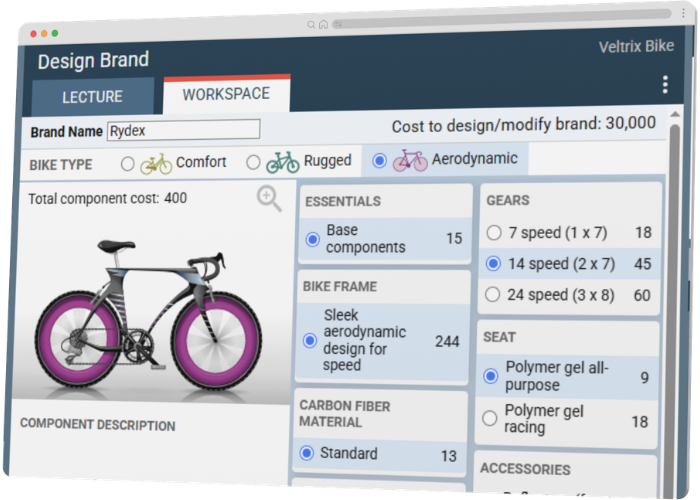
Competitive Marketing Simulations
Immerse your students in the competitive world of marketing. Students play against classmates or the computer as they build a the marketing division for a 3D-printed bicycle company. They’ll learn to study customers, respond to competition, and refine their marketing strategy quarter by quarter.

Introduction to Marketing
Engage beginner students with the core concepts of marketing.
Your marketing students will use customer research to formulate an initial marketing strategy and make brand, price, advertising, and distribution decisions. Each quarter, customer feedback, competitor data, and profitability reports will challenge students to adjust their strategies.
The Introduction to Marketing simulation is ideal for novices. It’s often used in core curriculum or Marketing Principles courses.

6 decision rounds, 3 to 6 hours of gameplay

Small to large classes of marketing novices

Play against classmates or computer

Strategic
Marketing
Take marketing students to a higher level. This game builds on Introduction to Marketing with with more market segments, brand options, advertising choices, sales outlets, and market reports.
Students also get to experiment with more resource planning and advanced marketing techniques, such as brand promotions and sales force initiatives.
The Strategic Marketing simulation is ideal for upper undergraduates in intermediate to advanced marketing strategy courses.
8 decision rounds, 8 to 16 hours of gameplay
Small to large classes of marketing majors
Play against classmates or computer

Advanced Strategic Marketing
Experience marketing at its fullest. Your advanced students will deal with more complex market research data and learn to manage campaigns in up to 20 regions of the world.
Students will also have more ways to respond to market demand, with more product design and ad design options than ever before. With a limited budget, managing priorities has never been more critical.
The Advanced Strategic Marketing simulation is ideal for advanced undergraduate and MBA students.
8 decision rounds, 8 to 16 hours of gameplay
Smaller classes of marketing majors
Play against classmates or computer
Marketing Microsimulations
Help your students understand core marketing concepts in just 10 to 25 minutes! Built on microlearning theory, each Microsimulation is a mix of bite-sized animated lectures and interactive challenges. Students play individually and can repeat the exercises as many times as they need.

The Microlearning for Marketing Collection
10 to 25 minutes each

Customized for your class
Any class size
Give your student vital practice in product design, profitability, online marketing, online paid advertising, strategic planning, pricing, and price elasticity. Use our premade bundles or create an original bundle to fit your class’s needs.

Need help deciding?
We’ll help you find the best marketing simulation for your class!
Join Professors Worldwide Who Use Marketplace Marketing Simulations
“Marketplace is incredibly realistic. No simulation can completely replicate what it’s like to be a … marketing manager, but this game is really, really close, and I tell my students that with conviction, and they get it.”
—Brian McCarthy, professor at Portland State University
“This was an amazing learning experience, and through it, I have gained a deeper understanding of marketing strategy and how to develop, implement, and improve a synergized and successful marketing plan.”
—James Caustrita, student at Grand Canyon University
“I use Marketplace Simulations in every marketing class I teach. Everything in this simulation is best in class. … Students in the game do everything real life marketers do, and they love competing against each other.”
—Tom Elmer, professor at West Chester University
“We learned how to analyze the market, develop a unique value proposition, and build a sustainable competitive advantage.”
—Sumedh Gurav, masters student at Oxford Brookes University
“Let me tell you, it was a journey of discovery! I found myself delving into areas I hadn’t explored before, expanding my knowledge and skills.”
—Nadia Aouall, masters student at Ecole de Management Leonard de Vinci
“I enjoyed having a project where we could exercise our knowledge and actually use strategic thinking from our course content to build a successful plan.”
—Mei Lin Cheung, student at Thompson Rivers University
Meet Assurance of Learning Standards for Your Accrediting Body






Frequently Asked Questions
What is a marketing simulation?
A marketing simulation is a computer-based learning experience where students make marketing decisions for a simulated company in a competitive market. Students analyze data, identify target audiences, set pricing, launch marketing campaigns, and respond to changing market conditions.
As the simulation progresses, students see how their decisions affect customer demand, brand performance, sales, and profitability. This allows them to test strategies, evaluate results, and refine their approach over multiple decision rounds.
Unlike passive learning methods, marketing simulations give students hands-on experience applying marketing concepts in a realistic business environment.
How do marketing simulation games work?
Marketing simulation games place students in charge of marketing decisions for a simulated company. In Marketplace’s competitive marketing simulations, students can play individually or in teams, competing against classmates or computer-controlled teams.
During each decision round, students study market research, evaluate customer needs, and make choices about product design, pricing, advertising, distribution, and sales strategy. After the round is processed, they receive performance results showing what worked, what didn’t, and how their competitors performed. Then they adjust their strategy for the next quarter.
Marketplace also offers Marketing Microsimulations, which work differently. These short, non-competitive activities focus on one marketing concept at a time. Students learn through bite-sized animated videos and simple interactive challenges, usually in 10 to 25 minutes. They are ideal for introducing, reinforcing, or reviewing specific marketing topics without running a full competitive simulation.
What do students learn in marketing simulations?
Marketing simulations help students understand how marketing strategy plays out in a competitive business environment. As students make decisions for their simulated company, they see how choices around pricing, advertising, product design, and distribution affect customer demand, brand performance, and profitability.
Throughout the simulation, students learn how to analyze market research and adjust their strategy based on performance results. They begin to see how different parts of a marketing plan work together—and how even small decisions can influence long-term success.
By the end of the experience, students have practiced thinking strategically, interpreting data, and making decisions under pressure.
How do professors use marketing simulations in college courses?
Professors use marketing simulations in many different course formats. Simulations can be used in online or in-person classes, completed live during class sessions or asynchronously outside of class, and integrated into short intensive courses or semester-long experiences.
Some instructors use competitive simulations as a major course project, while others incorporate shorter Microsimulations to reinforce individual marketing concepts. Optional assessments, coaching tools, and performance reports also make it easier to guide students and measure learning outcomes throughout the experience.
Learn more about different ways to teach with simulations on our Course Design Options page.
What makes a good marketing simulation?
A good marketing simulation combines realistic decision-making with meaningful learning support. Students should be making true-to-life marketing decisions—such as analyzing customer needs, adjusting pricing, or refining strategy—while clearly seeing how those choices affect business performance.
Strong marketing simulations also help students understand why results happen. Built-in learning materials, coaching tools, and performance feedback help connect marketing theory to real-world outcomes instead of turning the experience into trial and error.
The best marketing simulations balance engagement with academic rigor. They should be flexible enough to support different course formats and skill levels while still challenging students to think strategically and adapt over time.
How do I choose the right marketing simulation for my course?
Choosing the right marketing simulation starts with your course goals. Think about what concepts and skills you want students to practice, how much time you want to dedicate to the experience, and whether the simulation will serve as a major course project or a supplemental activity.
You should also consider your students’ experience level. Some marketing simulations are designed for beginners learning core concepts, while others challenge advanced students with more complex strategy, competition, and market analysis.
Short Microsimulations can work well for reinforcing individual topics, while larger competitive simulations provide a deeper, more immersive experience over multiple decision rounds. The best marketing simulation is one that fits your course format while helping students actively apply marketing concepts in a realistic setting.
Talk with our team to find the right simulation for your course’s needs.

Got questions? Need help structuring your class? Talk with our support team seven days a week!
Key differences between Marketing Simulations
| Simulation |  Introduction to Marketing |  Strategic Marketing |  Advanced Strategic Marketing |
|---|---|---|---|
| Description | Introduces the basic concepts of marketing. Based on customer needs, students formulate an initial marketing strategy and make brand, price, advertising, and distribution decisions. Customer feedback, competitor data, and profitability reports challenge students to adjust their strategy in a dynamic and highly competitive environment. | Strategic Marketing takes the intro marketing decisions to a higher level. There are more market segments, brand and advertising options, sales outlets and market reports. Includes more resource planning and advanced marketing techniques such as brand promotions and sales force incentives. | Compared to Strategic Marketing, this simulation offers more complex market research data, a greater number of regions to enter and more options in brand design and advertising. It is marketing at its fullest. |
| Typical courses | Marketing principles courses, often core curriculum | Intermediate/advanced marketing strategy | Capstone marketing strategy |
| Educational level | Ideal for novices to marketing, even non-majors or high school seniors | Third and fourth year undergraduates | Advanced undergraduate and MBA students |
| Decision rounds | 6 decision rounds of 30-60 minutes | 8 decision rounds of 1-2 hours | |
| Class size | Small to large classes (1000+) of marketing and non-marketing majors. | Smaller classes of marketing majors. Up to 8 teams per game, 4 – 6 teams of 4 students is optimal. | |
| Gameplay | Compete against classmates or the computer | Compete against classmates or the computer | Compete against classmates |
| Languages | English*, Portuguese-Br*, Spanish*, Polish, Russian, Korean*, French*, Deutsch | English*, Spanish, Polish, Lithuanian, Korean* | English*, Korean* |
*Language available in Bike edition.