

Coming 2027
Chocolate Challenge
Introduce students to business principles with an engaging game designed to be played on a phone, tablet, or desktop. The Chocolate Challenge is a small business simulation that invites students to build a home-based chocolate business with a small budget and local selling opportunities.

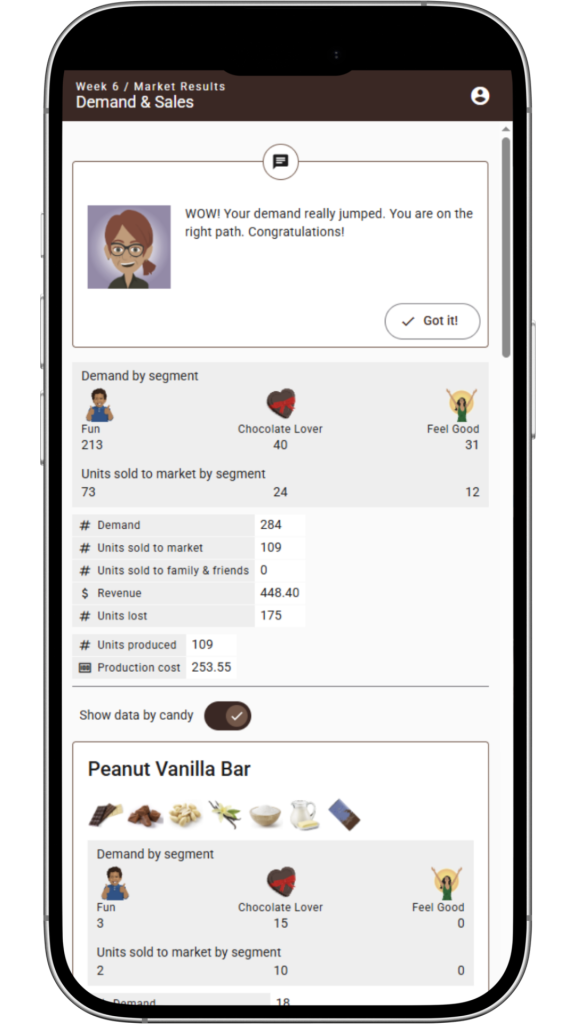
A Small Business Simulation for Beginners
The Chocolate Challenge lets learners build a home-based chocolate business from the ground up. Students develop products for different customer segments and learn how early business decisions can shape results.
Each week, students choose:
- What segment to target
- How to design their chocolate recipes
- How to present and market their chocolates
- How many to produce
- Which markets and festivals to book for selling
- How to respond to customer demand
Designed for learners with little to no business background, the simulation emphasizes learning by doing. Business students, high school learners, and aspiring entrepreneurs experience how running a small business really works.

Support line open seven days a week

Entrepreneurs, college, high school

8 decision rounds, about 1 hour each

Unlimited class size

Play on phone, tablet, or desktop
Develop Business Skills in a Low-Risk Environment
Brand Design
Use market research and customer feedback to develop chocolates for up to three segments. Through trial and error, players refine recipes, and packaging to better match customer preferences.
Pricing
Experiment with pricing to balance customer demand, costs, and profits. Track results over time to see how price changes influence sales performance and financial sustainability.
Sales Channels
Choose where to sell each week. Local farmers markets and festivals each come with unique costs and opportunities. Locations vary in planning requirements and attract different customer segments.
Production
Manage small-scale production from a home kitchen. Invest in training and equipment to improve quality, increase capacity, and efficiently meet customer demand.
Advertising
Design packaging and signage to promote chocolates at each venue. Experiment with visuals and wording to see how marketing decisions affect customer interest and sales.
Cash
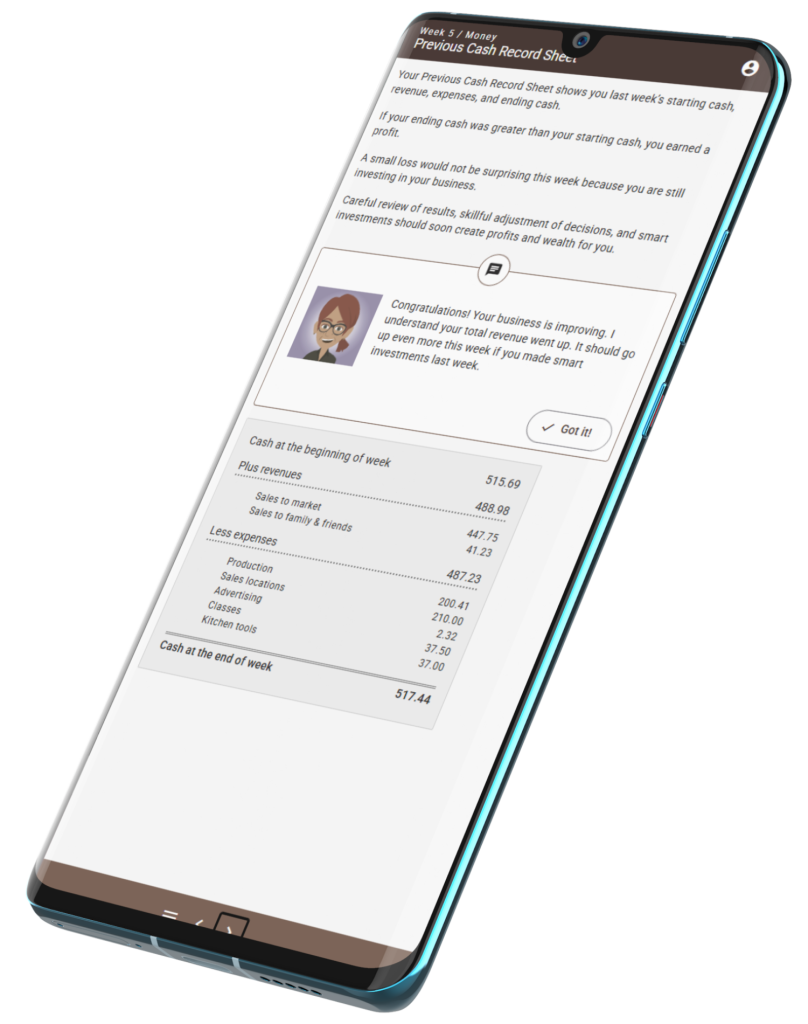
Start with limited cash and make careful investments that support growth. Balance spending and revenue to manage risk and keep the business viable.
Explore a New Way to Teach Business Principles
Who Should Play the Chocolate Challenge?
The Chocolate Challenge is designed for learners who are new to business and want to clearly understand it. By starting with a small business, they can easily see the whole picture and how all the parts work together.
This simulation is a strong fit for:
- Students in introductory entrepreneurship, business, and marketing courses
- High school students in economics or entrepreneurship classes
- Aspiring entrepreneurs looking to build skills and confidence
Frequently Asked Questions
Can the Chocolate Challenge be played on a tablet or smartphone?
Yes. The Chocolate Challenge is a small business simulation designed to work smoothly on smartphones, tablets, and laptops. There is no software to download, making it easy to use in school classrooms, nonprofit programs, or independent learning environments.
Its simple design keeps the focus on making practical business decisions rather than navigating complex interfaces. Learners concentrate on managing their business, responding to customer demand, and improving their results over time.
What types of decisions do students make in the Chocolate Challenge?
Learners make practical, decisions across branding, pricing, production, sales locations, advertising, and cash management. Each week requires them to evaluate customer demand, review results, and adjust strategy to improve performance.
As a small business simulation, the experience focuses on real-world tradeoffs. Learners must balance customer preferences, operating costs, and profit goals while working with limited resources. Over time, they see how their strategic decisions influence sales, cash, and overall business growth.
What features should I look for in a small business simulator?
The hallmark of a strong small business simulator is that it allows learners to practice realistic management decisions. Look for simulations that require students to analyze customer demand, manage costs, allocate resources, and adjust strategy based on measurable results.
The best business simulation games go beyond surface-level play. They connect decisions across marketing, operations, and finance, provide clear performance feedback, and reflect real-world cause-and-effect relationships. Students must solve complex problems and think creatively with a strategic mindset. Marketplace Simulations designed its Chocolate Challenge around these principles, ensuring that students build the skills to become future-ready professionals.
How is the Chocolate Challenge different from other introductory business simulations in the Marketplace Simulations catalog?
In the Chocolate Challenge, students focus on running a small, home-based business. With a starting budget of just $500, they learn business principles on a smaller scale that is easier to understand. The simplified setting is an ideal entry point for students who are new to management simulations and small business strategy.
Our other introductory business simulations are built around a corporate setup scenario. There, students manage investor funds and get a taste of corporate structures and all its functional departments.
What learning settings is the Chocolate Challenge designed for?
The Chocolate Challenge is flexible enough for a wide range of learning environments, including business school courses, nonprofit or government-supported small business programs, and short-format training workshops. Because it’s structured as a repeatable weekly cycle, facilitators can use it for guided instruction, group discussion, or independent practice.
The scenario is easy to grasp for business newcomers, and the results-based feedback supports both coaching and reflection. This makes it a practical option for organizations that want learners to build real-world decision-making skills in a low-risk setting.
Is the Chocolate Challenge appropriate for both high school and college students?
The Chocolate Challenge is designed to be accessible for high school students while still offering enough depth for college-level courses. The small business scenario is easy to understand, allowing younger learners to grasp core concepts without being overwhelmed by corporate complexity.
At the same time, the simulation requires students to make strategic decisions, analyze results, and adjust their approach over time. This makes it suitable for introductory business, marketing, economics, and entrepreneurship courses in both secondary and higher education settings.
What makes the Chocolate Challenge a good small business simulation game?
The Chocolate Challenge stands out as a small business simulation game because it combines simplicity with meaningful decision-making. Students start with limited resources, respond to customer demand, and see how their choices affect sales, costs, and overall performance.
Unlike many tycoon-style games, the focus is not just on rapid expansion or entertainment. The simulation is built around real-world cause-and-effect relationships. This helps learners understand how strategic decisions influence market share, costs, profitability, and long-term sustainability. Marketplace Simulations designed the experience to reflect how small businesses operate in real life while keeping the learning process clear and approachable.