

Reaching Every Student in a Large Course: Meet Dr. John Eaton

Giving more than 1,200 students the same engaging, quality learning experience is no small task. This is the challenge Dr. John Eaton manages every semester in his Introduction to Marketing class at Arizona State University.
“We’re just so big that we are constantly growing and adding,” Eaton says.
His course is required for all majors within the college of business, and it’s offered in three formats.
First, Eaton oversees two fully in-person sections. The second format is an online class where the full semester’s work is fitted into just eight weeks. Finally, Eaton offers his course to an independent part of the university called ASU Online. These students study exclusively online and will likely never set foot on Arizona State’s campus.
Regardless of the format, Eaton is guided by his belief that students learn best through applied learning rather than memorization. Using the Introduction to Marketing simulation by Marketplace® has been essential in consistently providing that experience to each of his classes.
A Teaching Philosophy Built on Real Learning
Eaton has always strived to make his classes built around practical experience rather than memorization. Long before he began using Marketplace Simulations, he moved away from traditional textbook based teaching.
“Students can Google any marketing [term] … but it is up to me to provide timely things that are happening today,” he says.
Eaton’s goal is to help students think critically and understand how marketing decisions work in real life. The Introduction to Marketing simulation is a natural fit for his teaching style, as it allows him to give every student a hands-on experience that reflects the core ideas he wants to convey.
In the simulation, students build their own marketing division. They take on the challenges of building a strategy, designing campaigns, implementing those campaigns, and assessing their results. Quarter by quarter, they adapt and innovate to get ahead of their competitors.
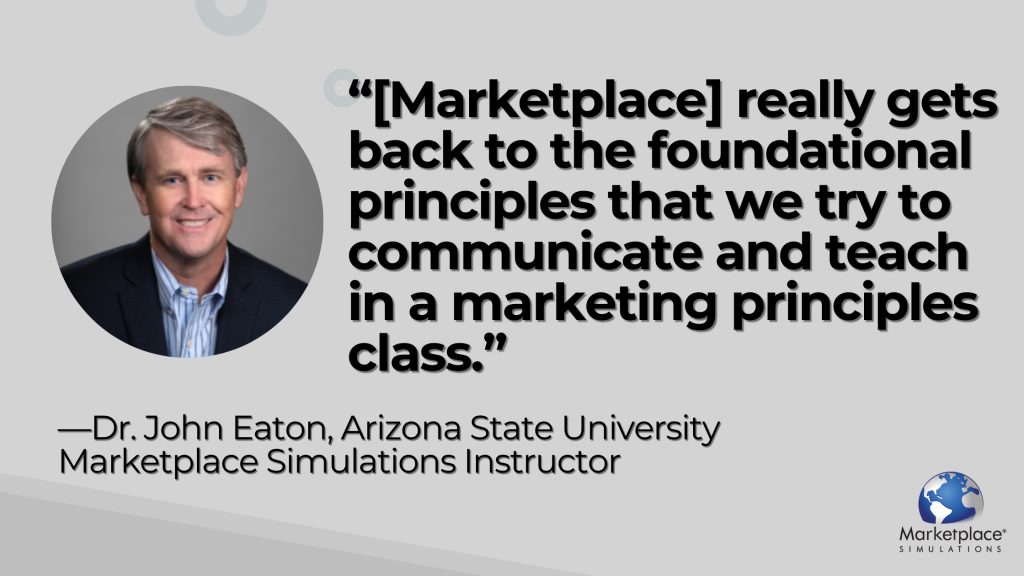
“It really gets back to the foundational principles that we try to communicate and teach in a marketing principles class,” he says. “It does a great job of illustrating segments from the very beginning and the cause and effect of how interrelated all of these things are.”
The simulation also supports the deeper concepts he brings in from his advanced courses, including consumer behavior, marketing research, and strategy. It delivers the kind of real world thinking he values while remaining scalable for large and diverse classes.
Not Compromising on Quality Through Online Learning
Students often believe that they can coast through an online course without doing any meaningful work. Eaton ensures that this is not the case when he jumps from his in-person to online sections.
“This is not a shortcut degree,” he says. “Just because you are online instead of being in the room with me at the same time, this is not going to be easy.”
Because the hands-on approach requires meaningful work, the simulation creates structure, consistency, and sparks interest across all formats. It brings the kind of energy that matters to students—even when learning online.
“I do not think people have ever gotten that fired up over any of my lectures about any topic ever,” Eaton says.
Post-Simulation Essay to Reflect on Students’ “Why”
Marketplace’s Balanced Scorecard and Automated Coaching Assistant shows Eaton where his students are thriving, struggling, and growing. However, he likes to go deeper by giving students a writing assignment at the end of the simulation. This paper counts as much to their grade as their simulation performance score. The goal is to help students explain the thinking behind their decisions.
He shared his assignment can be summed up by asking, “Why did you do that?” He asks students to get specific: “Why did you run 12 ads instead of 30 ads? Or why did you pick that price point? If it turned out to be a bad result, what did you learn from it?”
This assignment helps students slow down and reflect. They use reports, review their choices, and understand why their strategy did or did not work. It also gives Eaton deeper insight into how students think.
“I can tell you what your grade is going to be on the simulation based on the questions you ask,” he says. “If you are asking how many ads you should run, that is the wrong question. I want to hear why.”
Simulation-Based Learning Helps with Recommendation Letters
With 1200 students, it’s hard to get to know everyone personally. Still, Eaton regularly receives requests for recommendation letters. Using insights from the simulation’s reports and the reflection paper, it helps him to write meaningful recommendation letters every time. He may not know each student personally, but he can easily go back to their game and see where they excelled.
“I have had students that I have written recommendation letters for who said from their job interview that being able to talk about the application, the real-world strategy, thinking it through in the simulation made it much more likely that they got the job,” he says.
Additionally, Eaton shared that students often reach out years later to ask if their scores still stand so they can share them in interviews. The simulation not only gives Eaton clear evidence of their abilities, but it allows students to leverage an in-class experience to future employers.
A Long-Lasting Partnership
After more than two decades, Marketplace is still a core part of Eaton’s teaching. When asked if he had ever considered switching to a different simulation provider, he says, “End of story. No. Zero. It does exactly what I need it to do.”
Thousands of his students agree. As they step into advanced courses and job interviews, they consistently rely on the skills they developed in the Introduction to Marketing simulation. For them, it isn’t just an introduction to marketing, it’s a steady foundation for their lifelong careers.
Do you want to challenge your large online section? Explore how Marketplace Simulations can reach every student in your classroom.


Arden Jordan is a marketing associate at Marketplace Simulations and a graduate of the University of Tennessee’s Haslam College of Business. After experiencing Marketplace firsthand as a student, she now helps share its story to educators through marketing and creative content.