
The Group Project That Finally Worked: One Student’s Journey from Burnout to Buy-In
Group projects are often hardest on the students who care the most. Apathetic students assume someone will do their work for them, while committed students often feel they have no choice but to pick up their slack. The result is often that the workload falls on one or two students while others take a backseat.
That is what Frances Garcia-Rodriguez expected heading into her capstone strategy course at Texas A&M International University.
When her professor announced that the class would play a business simulation, Frances anticipated dry spreadsheets and an unfair workload. What unfolded instead was a team experience that gave her a new sense of confidence and the skills she needed to help her launch a career in logistics.
The Dreaded Group Project
Frances had an unconventional academic journey. After leaving college early and spending years in customer service, she returned to school full-time, fully motivated to build herself a better future. In the process, she became deeply familiar with group work—but not in a good way.
Frances found that she was often the one managing the entire assignment while others coasted by. “If I didn’t step up, nothing would get done,” she said.
This time, however, things were different.
“It’s like a Greek god where he’s holding a boulder—yes, I’m holding that boulder. This was the first team where I wasn’t holding the whole boulder,” Frances said.
A Student Team United by Fun
The Strategy and Business Policy game by Marketplace Simulations introduces a realistic business scenario wherein student teams compete with each other as startup bike companies. Frances was skeptical at first, but her perception quickly changed once her group started the simulation.
“It turned out to be something that wasn’t what I thought it was going to be. … It was fun,” Frances said.
Her team even communicated outside of class to make decisions, troubleshoot strategy, and stay on track each week. Everyone contributed, and no one stuck to a single role.
“We all just got on there and went over everything and discussed everything with each other” she said.
As the game progressed, the team’s desire to succeed grew. Together, they reviewed the balanced scorecard, analyzed metrics, and made improvements. They even came up with a shared rule: never let their bank account fall below $300,000.
“We always made sure we had room in the budget in case we made a mistake and had to pay for it,” she explained. The team never wanted to go into debt—and they never did.
Building Skills, Reinforcing Knowledge
What stood out most to Frances was the way the simulation surfaced everything she had learned throughout her education in accounting, marketing, finance, and operations.
“It gave me the confidence, the recognition that I haven’t just been coasting by,” Frances said. “I’ve actually learned throughout my years in school, and stuff has been sticking.”
That realization was powerful. It reassured her that the effort she had put into her schooling over the years had taken root and was useful.
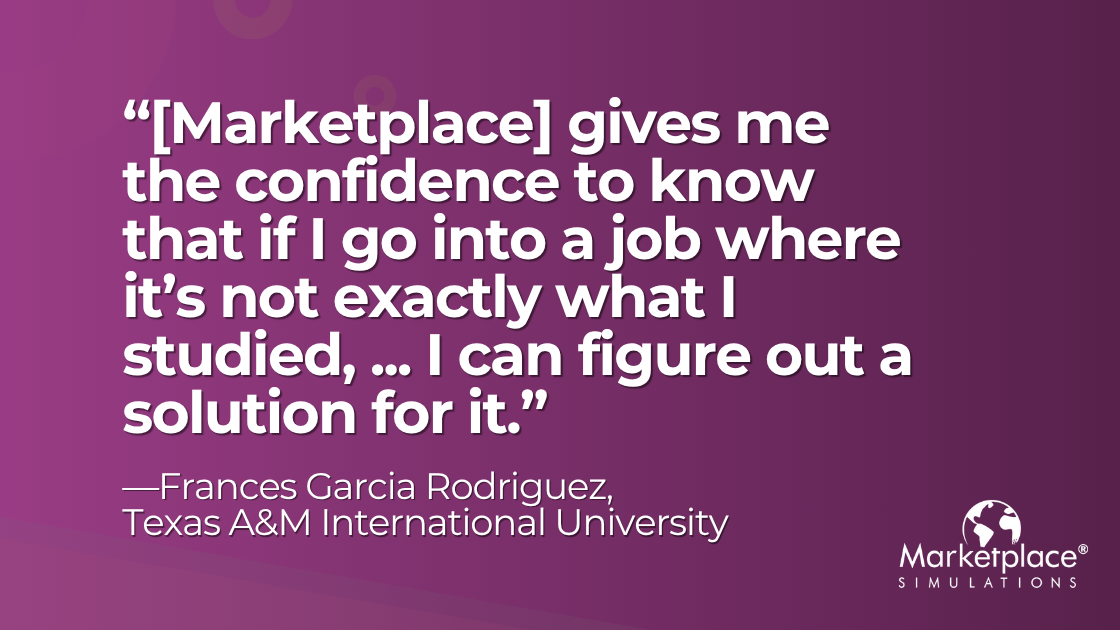
“It gives me the confidence to know that if I go into a job, into a field where it’s not exactly what I’ve studied, I have the confidence in knowing that as long as I focus, as long as I know what I’m looking for, I can figure out a solution for it,” Frances shared.
Her team finished strong, winning first place despite not always leading in market share. For Frances, who had taken 18 credit hours that semester, the ability to count on her team made all the difference.
Developing a Competitive Edge for the Real World
What initially seemed to be a typical group project turned into one of the most practical experiences of Frances’s college career. The simulation gave her space to apply what she’d learned, work with a balanced team, and make strategic decisions that felt real.
It also gave her something concrete to take into the job market. She now references the experience in interviews.
“We can put it on our resumes and our LinkedIn and show other businesses what we’re capable of as students,” Frances said. “That makes us stand out. It’s a nice little boost, and it’s something that we can take away from a course.”
Today, Frances works as an account executive at an international logistics company, focusing in sales, negotiation, and customer service. For her, the simulation experience extended far beyond the classroom—it became a defining moment that helped launch her career with confidence.
Do you want to give your students a group project that truly engages everyone and inspires real teamwork? Explore how Marketplace Simulations can bring collaboration to life in your classroom.

Arden Jordan is a marketing associate at Marketplace Simulations and a graduate of the University of Tennessee’s Haslam College of Business. After experiencing Marketplace firsthand as a student, she now helps share its story to educators through marketing and creative content.